When an Appointment Request Is Not a Booking Yet
A caller asking for time is not the same as a confirmed calendar slot; here is how operations teams manage the unresolved request state and route the follow-up.
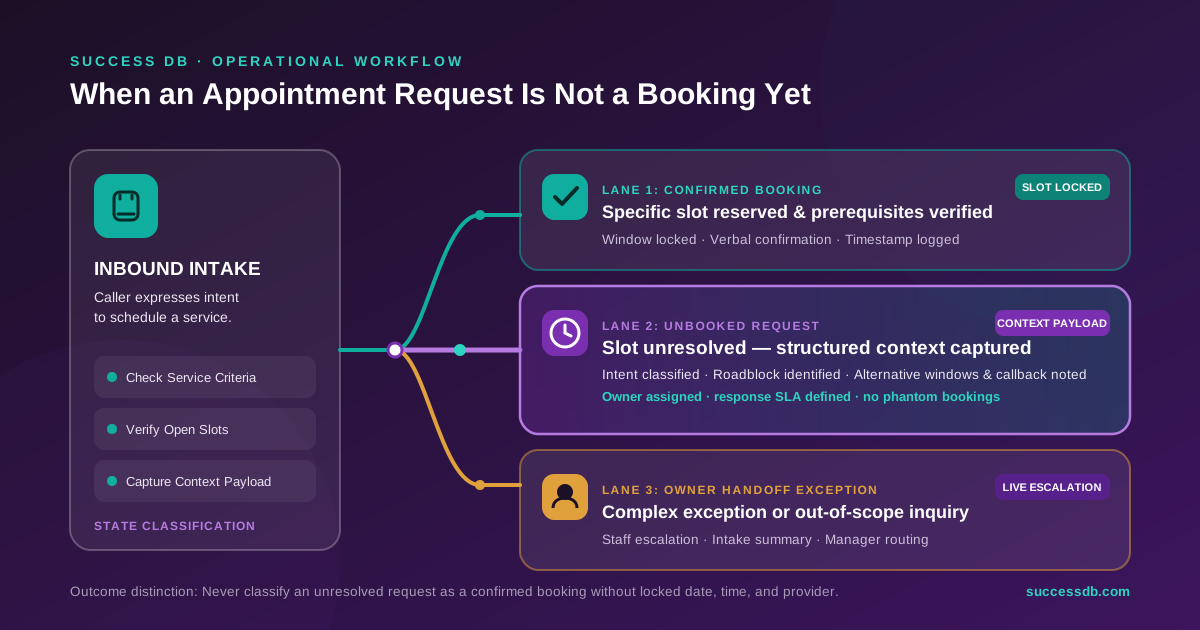
In appointment-driven businesses and service organizations, it is easy to mistake caller intent for a completed outcome. When a prospective client or patient calls and says, "I need to see someone next Tuesday morning," frontline teams frequently record the event as an "appointment."
Yet until that conversation meets the explicit operational criteria for confirmation, it is not a booking. It is an unbooked appointment request.
Treating an unbooked request as a confirmed booking creates operational chaos: service providers show up to empty appointment windows, double-bookings occur when callers assume a slot was held, and administrative staff waste hours untangling missed expectations. Conversely, treating an unbooked request as an unguided generic voicemail or raw lead note creates friction, delays outreach, and causes high-intent callers to book with a competitor.
The core decision for an appointment operations lead is defining the exact boundary between a request and a booking, ensuring the inbound call captures the necessary operational context for manual resolution, and establishing clear follow-up ownership when availability remains unresolved—all without relying on unverified assumptions about calendar automation or guaranteed attendance.
1. Distinguish an unbooked request from a confirmed slot
The first step in building a reliable appointment workflow is establishing strict criteria for what constitutes a confirmed booking versus a pending request. Inbound calls generally fall into one of three distinct operational states:
[ Inbound Caller Intake ]
          │
          ├─────────────────────────┬─────────────────────────┐
          ▼                         ▼                         ▼
   [ State 1: Confirmed ]    [ State 2: Request ]     [ State 3: Handoff ]
   - Slot locked             - Intent captured        - Complex exception
   - Criteria verified       - Slot unresolved        - Out-of-scope inquiry
   - Direct calendar entry   - Structured follow-up   - Live staff escalation
State 1: The Confirmed Booking
An appointment is confirmed only when all operational conditions required by your business are satisfied during the conversation:
- Specific Time Slot Reserved: A mutually agreed, distinct calendar window has been locked for a specific provider or service resource.
- Service Prerequisites Verified: The caller satisfies the baseline criteria for the appointment (e.g., location eligibility, required intake forms, referral requirements, or service-type alignment).
- Direct Contact Confirmed: The caller's name, direct callback number, and communication preferences are verified.
- Mutual Understanding Established: The caller receives verbal confirmation of the exact time, location, and preparation requirements before ending the call.
State 2: The Unbooked Appointment Request
An unbooked request occurs when a caller expresses clear intent to schedule, but the slot cannot be finalized during the call. Common operational causes include:
- Availability Mismatch: The caller requests a specific provider or timeframe that is currently full, requiring manual schedule adjustment or a waitlist spot.
- Prerequisite Uncertainty: The appointment requires clinical triage, insurance verification, preliminary quote approval, or supervisor authorization before a time can be committed.
- Caller Hesitation: The caller wants an appointment but must verify their own calendar, coordinate with a spouse, or confirm transportation before locking in a slot.
- Multi-Resource Scheduling: The service requires coordinating multiple staff members, equipment rooms, or field vehicles that cannot be locked instantly.
In this state, the caller does not have an appointment. They have initiated a pending service request that requires a dedicated follow-up action.
State 3: The Owner Handoff Exception
As detailed in our guide on when an appointment call needs more than a booking request, certain calls exceed the bounds of standard scheduling entirely. Callers seeking urgent escalations, disputing a cancellation policy, or requiring custom account handling should not remain in a self-serve scheduling queue. They must route directly to an accountable staff member.
Operational Rule: Never allow an inbound agent or intake staff to classify a call as "Booked" unless the specific date, time, and resource are locked. Classifying an unbooked request as a confirmed booking is the leading cause of phantom cancellations and calendar confusion.
2. What context does the follow-up owner actually need?
When an appointment request cannot be booked on the initial call, logging a generic note like "Caller asked about appointment next week" creates unnecessary friction. The staff member tasked with follow-up must spend the first five minutes of the return call re-asking basic questions, frustrating the caller and reducing the likelihood of completing the booking.
To enable swift, professional manual follow-up, an inbound call record must capture five specific operational data points:
1. Stated intent and service classification
- Exactly what service, procedure, or consultation does the caller require?
- Is this a first-time client or an existing account?
- Does the service require standard or specialized provider skills?
2. Time preferences and flexibility boundaries
- What is the caller's ideal day and timeframe (e.g., "Tuesday morning between 9:00 AM and 11:00 AM")?
- What are their acceptable alternative windows (e.g., "Any weekday after 3:00 PM if Tuesday is unavailable")?
- What is the urgency level (e.g., immediate same-week need vs. flexible within the next month)?
3. The exact scheduling roadblock
- Why was the appointment not confirmed during the initial call?
- Was the requested provider fully booked?
- Is the caller waiting on internal approvals, medical records, or third-party coordination?
- Documenting the specific roadblock prevents the follow-up coordinator from pitching options that were already declined.
4. Verified contact details and callback parameters
- Direct telephone number and caller name.
- Preferred callback window (e.g., "Best reached during lunch hour between 12:00 PM and 1:00 PM").
- SMS consent status (if the caller consented to text communication under our Terms of Service to receive status updates).
5. Clear ownership and target response timeframe
- Which team member or department desk owns the return action (e.g., Front Desk Triage, Patient Coordinator, Account Executive)?
- What is the expected response window (e.g., same-day callback by 5:00 PM)?
Carrying this structured context forward ensures that when your staff reaches out, they begin the conversation from a place of competence: "Hello Sarah, I see you were looking for a consultation with Dr. Miller on Tuesday morning. That slot was full, but I have two openings on Wednesday at 10:00 AM or Thursday at 2:00 PM that fit your schedule."
3. How to handle unresolved availability and caller questions on the call
Handling an unbooked request requires careful conversational management. The inbound agent must maintain caller confidence without making commitments that your operations cannot fulfill.
Here is how appointment-driven teams structure inbound call paths for unresolved scheduling:
Never make false availability promises
If a caller demands a specific time that is unavailable or unverified, the agent must clearly state that the requested window is not currently open, rather than offering vague reassurance. Transparent boundary-setting prevents caller disputes later.
Offer structured alternative windows
When the primary request cannot be met, provide approved alternative parameters configured for your team:
- "Dr. Miller is fully booked this Tuesday, but she has availability on Wednesday morning or Friday afternoon. Would either of those windows work for you?"
- If the caller cannot commit immediately, capture their preferred fallback range for coordinator review.
Answer approved common questions before pushing for a slot
Often, a caller hesitates to book because they lack essential information about pricing, location, parking, or appointment duration. As outlined in our appointment-call checklist, an inbound agent should answer approved, factual business questions directly. Removing these informational roadblocks often converts a hesitant caller into an immediate booking.
Transparently explain the next step
If a request cannot be confirmed, conclude the call by setting an explicit operational expectation:
- "I have recorded your request for a consultation next week along with your morning time preferences. Our scheduling coordinator, Alex, will review provider availability and follow up with you by 4:00 PM today to finalize your time."
- Never send a generic calendar placeholder or imply that an automatic invite has been dispatched when the time is unconfirmed.
4. Illustrative request-state worksheet
Before configuring your inbound call flows, use this operational planning worksheet to define how your organization classifies, documents, and routes unresolved appointment requests.
| Intake Field / Factor | Confirmed Booking State | Unbooked Request State | Escalated Handoff State |
|---|---|---|---|
| Operational Trigger | Caller selects an open, approved calendar window matching service criteria. | Caller requests an unavailable time, has pending prerequisites, or needs callback. | Caller reports an emergency, disputes a charge, or demands a named manager. |
| Calendar Status | Slot locked and reserved in calendar schedule. | No calendar slot held; recorded as pending triage. | No calendar slot held; direct live transfer or urgent alert. |
| Required Context Payload | Confirmed date/time, client name, service type, provider ID. | Requested date/time range, flexibility, reason unbooked, callback window. | Caller identity, reason for escalation, previous interaction summary. |
| Caller Confirmation | Verbal confirmation of specific time, address, and arrival instructions. | Verbal confirmation of request receipt and designated callback timeframe. | Direct introduction to staff member or notice of immediate supervisor review. |
| CRM / Record Status | Status: Booked with scheduled timestamp. |
Status: Pending Request with triage context notes. |
Status: Escalated / Human Handoff with routing owner. |
| Downstream Ownership | Service Provider / Front Desk arrival roster. | Scheduling Coordinator / Follow-Up Triage Desk. | Designated Account Owner or Clinic Supervisor. |
| Target Action SLA | Provider prepares for arrival at designated time. | Coordinator initiates outbound callback within business window. | Immediate phone transfer or urgent priority ticket. |
(Note: This worksheet is an illustrative operational planning tool for internal workflow design. It does not represent an automated platform software module, a live calendar synchronization guarantee, or an automated reminder system.)
5. Commercial terms and setup with Success DB
Understanding how Success DB structures its service boundaries, onboarding, and ongoing operational changes ensures your appointment flows remain reliable and sustainable.
Sales-assisted setup and in-platform configuration
Success DB combines expert onboarding assistance with ongoing platform autonomy:
- Initial Setup: You do not have to configure complex scheduling decision trees alone. When you begin service, a sales agent assists you in establishing your initial call flow based on your business information, appointment rules, approved answers, and handoff protocols.
- Ongoing Edits: Operations evolve. As stated in our Terms of Service, later changes can be made directly in the platform, and support is available for additional assistance. When provider schedules change or new request categories are created, your team can adjust call rules in-platform or coordinate with support.
Transparent, predictable subscription pricing
Success DB operates under published, uniform commercial terms:
- Base Subscription: The standard AI Phone Agent subscription is $199 per month, billed month to month.
- No Setup or Onboarding Fees: There is no setup fee or onboarding fee ($0). Initial sales-assisted onboarding is included in the base subscription.
- Monthly Allowances: Each billing cycle includes 500 inbound voice minutes and 500 SMS text messages.
- Metered Overage Rates: Usage exceeding monthly allowances is billed at $0.12 per additional minute and $0.02 per additional SMS.
- Billing Terms: Cancel before the end of the current billing period to prevent renewal. Phone service remains available through the paid period, and incurred overages remain due. Refunds for prepaid monthly service are evaluated case by case.
Clear portfolio positioning: Success DB vs. Sibling Brands
To maintain clarity across our sister platforms:
- Success DB (
successdb.com): Built for appointment-driven and customer-success teams that want inbound calls to result in a booked appointment, a structured request, or an owner handoff with clean outcome records. It does not focus on raw, unfiltered lead capture. - Solutions HD (
solutionshd.com): Delivers productized, ready-made phone agents chosen from a standard package catalog for straightforward calling jobs. - Solution HD (
solutionhd.com): Delivers consultative, bespoke call flows for non-standard operational routing across multi-tiered departments. - US Lead Data (
usleaddata.com): Focuses on B2B sales lead qualification and pipeline routing before sales rep outreach.
Success DB provides the dedicated framework needed to turn high-intent appointment calls into documented, actionable business outcomes.
6. Illustrative scenario: Managing unbooked requests in a specialty therapy clinic
To see how an appointment operations team applies the request-versus-booking distinction in daily practice, consider the following illustrative example:
Illustrative Example
ClearPath Physical Therapy is a multi-provider outpatient clinic in Lincoln, Nebraska. The clinic receives over 70 inbound scheduling calls daily across three orthopedic therapy specialists. During peak morning hours, many callers request slots with the clinic's senior therapist, whose schedule is frequently filled two weeks in advance.
- The Operational Breakdown: Previously, front-desk staff marked any caller who requested an appointment as "Tentative" in the shared schedule, even when the senior therapist had no open slots. Patients assumed their appointment was locked, showed up unexpectedly, or grew frustrated when staff called days later to cancel the tentative entry. Unbooked callers often abandoned the clinic entirely.
- Implementing the Three-Lane Framework: ClearPath reworked its intake path into three explicit operational lanes using Success DB:
- Confirmed Booking Lane: Callers seeking routine physical therapy who accepted open slots with any available therapist were booked directly, and the date, time, and arrival directions were verbally confirmed.
- Unbooked Request Lane: Callers who insisted on seeing the senior therapist were informed transparently that her schedule was full for the requested week. The agent captured the caller's preferred days, acceptable alternative times (e.g., mornings after 9:00 AM), injury details, and callback availability. The call record was logged with
Status: Unbooked Request — Senior Therapist Waitlist.- Owner Handoff Lane: Callers with post-operative surgical referrals requiring immediate same-day evaluation were transferred directly to the clinical triage nurse.
- The Downstream Follow-Up: Each afternoon at 2:00 PM, the clinic's patient coordinator opened the Unbooked Request queue. Because each record contained the exact scheduling roadblock, preferred alternative windows, and direct callback numbers, the coordinator was able to contact 12 pending callers in under 45 minutes, offering newly opened cancellation slots or matching them with specialized associate therapists.
By formally separating unbooked requests from confirmed slots, ClearPath eliminated scheduling disputes, protected practitioner calendars, and ensured that high-intent patient inquiries received timely, coordinated follow-up.
(This scenario is an illustrative example designed to demonstrate operational workflow design; it does not represent an actual client endorsement, specific software integration, or guaranteed appointment attendance rate.)
7. Next actions for appointment operations leads
An appointment request is a valuable operational signal, but it is not a finished result. By defining clear boundaries between requests and confirmed bookings, capturing structured context during intake, and establishing accountable follow-up ownership, your organization can protect its schedule integrity while capturing every potential customer.
- Map your inbound appointment flow: Book a walkthrough to evaluate how your team can turn calls into booked slots and actionable records, or start AI Phone Agent service directly.
- Learn our process: Review How Success DB Works from first answer to outcome record.
- Explore appointment routing: Read Designing a call path for booking and rescheduling.
- Audit your call intake: Use our Appointment-call checklist for clear next actions.
- Handle complex calls: Review When an appointment call needs more than a booking request and When a customer-success call needs an owner handoff.
- Common questions: Visit our FAQ or review our full Terms of Service.